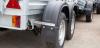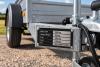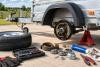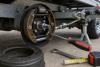

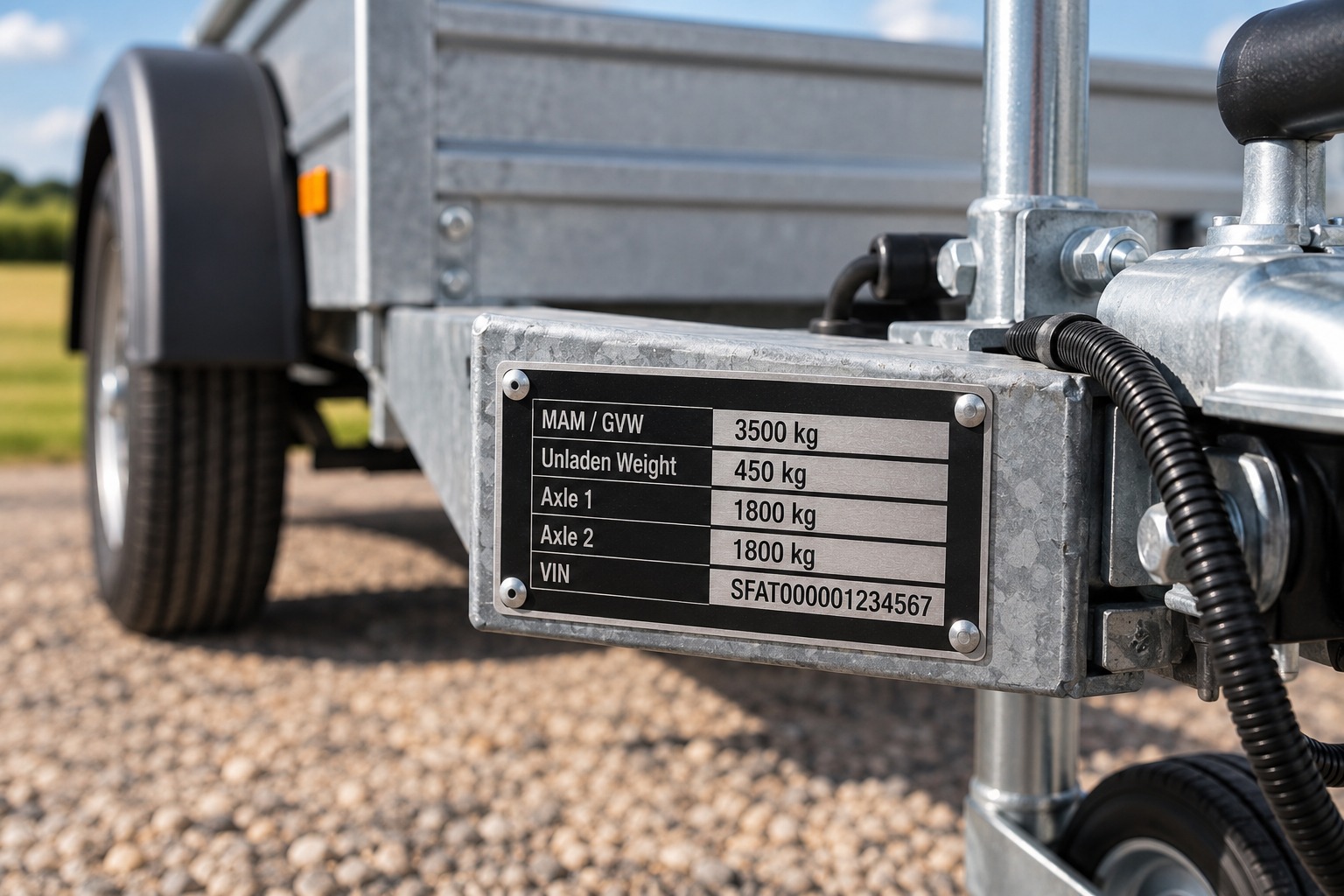
Every trailer sold in the UK has a weight plate fixed to the chassis — usually a small metal or plastic label riveted or bonded to the A-frame, drawbar or chassis rail near the front of the trailer. Most people ignore it, but the information on it is legally significant. Overloading your trailer or towing beyond its rated capacity is both dangerous and a criminal offence. This guide explains what each figure on the plate means and how to use them correctly.
Where to find the weight plate
On most UK trailers the weight plate is located on the A-frame or front chassis rail, within easy sight when you are standing at the front of the trailer. On box trailers and enclosed trailers it may be on the nearside front corner post. If you cannot find it, check any original documentation that came with the trailer — the same figures should appear in the registration or manufacturer's certificate.
The plate is a legal document. If it is missing, damaged or illegible, the trailer is technically not roadworthy and should not be used until a replacement plate is obtained from the manufacturer or the DVLA.
What the figures mean
The plate typically shows some or all of the following:
|
Field |
What it means |
Example |
|
MAM / GVW |
Maximum Authorised Mass — the maximum the trailer can weigh when fully loaded, including its own unladen weight |
MAM: 3500kg |
|
Unladen weight |
The weight of the trailer itself with no load |
Unladen: 450kg |
|
Payload |
What you can legally carry — MAM minus unladen weight |
3500 − 450 = 3050kg maximum load |
|
Max axle load (single) |
The maximum load a single axle can bear — must not be exceeded even if overall MAM is not reached |
Axle 1: 1800kg |
|
Max axle load (tandem) |
For twin-axle trailers, each axle has its own limit. Both apply simultaneously |
Axle 1: 1800kg / Axle 2: 1800kg |
|
VIN / chassis number |
Unique identifier for the trailer — needed for registration, insurance and parts ordering |
e.g. SFAT000001234567 |
MAM and payload — what you can actually carry
The most important figure for day-to-day use is the MAM (Maximum Authorised Mass), sometimes also labelled GVW (Gross Vehicle Weight) or MGW (Maximum Gross Weight). This is the maximum the trailer is permitted to weigh when loaded.
To calculate your actual payload — how much load you can put on the trailer — subtract the unladen weight from the MAM. For example, a trailer with a MAM of 3,500kg and an unladen weight of 600kg has a payload of 2,900kg. Load anything heavier and the trailer is overloaded, regardless of what the tow vehicle can tow.
If the unladen weight is not shown on the plate, it should be in the manufacturer's documentation. Do not estimate it — it varies significantly between trailers of similar size depending on the build materials and specification.
The 750kg rule — braked vs unbraked trailers
UK law requires that any trailer with a MAM over 750kg must have a braking system. This is one of the most important thresholds to understand. If your trailer has a MAM of 750kg or less, it can legally be used on public roads without brakes. If its MAM exceeds 750kg, it must have a functioning overrun braking system connected via a braked trailer coupling.
Note that the 750kg figure relates to the trailer's MAM, not what it is currently loaded with. A trailer with a MAM of 1,000kg is legally a braked trailer even if you are only loading 200kg on it. Check the plate, not the load. Browse our full range of trailer couplings if you need to identify or replace the coupling on a braked trailer.
Axle loads — the figure most people overlook
Where the weight plate shows individual axle load limits, these apply in addition to the overall MAM. It is possible to be within the overall MAM but to overload a single axle by distributing weight unevenly. Both conditions must be met simultaneously.
Axle load limits matter particularly for twin-axle trailers. If your trailer has two axles each rated to 1,800kg, the total from those figures is 3,600kg — but if the MAM is 3,500kg, you are still limited to 3,500kg overall. The axle limits are the maximum each axle can bear, not an invitation to add them together. Overloading an axle puts excessive stress on the axles and suspension and on the trailer wheels and tyres, and can cause a tyre failure or axle fracture.
Worked example — Ifor Williams LM85G flatbed
A typical Ifor Williams LM85G single-axle flatbed has the following plate figures:
• MAM: 2,700kg
• Unladen weight: approximately 540kg (check the actual plate — it varies by spec)
• Payload: 2,700 − 540 = 2,160kg maximum load
• Max axle load: 1,800kg
To stay legal, the loaded trailer must weigh no more than 2,700kg in total, the axle must bear no more than 1,800kg, and the weight of the load must be distributed sensibly — heavy items low and towards the front of the trailer to keep the nose weight within the coupling's rated limit.
UK driving licence rules and trailers
Your driving licence category determines what you can legally tow, regardless of what the trailer's plate says. The key rules in the UK are:
• If you passed your car test on or after 1 January 1997, you hold a Category B licence. You can tow a trailer with a MAM up to 3,500kg, provided the combined MAM of the tow vehicle and trailer does not exceed 3,500kg. To tow a combination exceeding 3,500kg combined MAM, you need a Category B+E entitlement, obtained by passing an additional trailer towing test.
• If you passed your car test before 1 January 1997, you automatically hold Category B+E entitlement and can tow trailers up to 8,250kg combined MAM without an additional test.
This means the trailer's plate alone does not tell you whether you can legally tow it — you need to check both the trailer's MAM and your vehicle's towing limit against your licence category. When in doubt, check the GOV.UK guidance on towing with a car licence or contact the DVLA.
Does the trailer need to match the tow vehicle?
Yes. Both the trailer's MAM and the tow vehicle's towing capacity must be respected — whichever is lower applies. Your tow vehicle's towing limit is shown on the vehicle VIN plate, usually located inside the driver's door frame or under the bonnet. If your vehicle is rated to tow 2,500kg but the trailer has a MAM of 3,500kg, your legal limit is 2,500kg. The trailer plate tells you what the trailer can carry — not necessarily what your vehicle can legally pull.
Shop trailer parts at TrailerTek
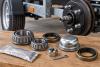
If you need to replace components on your trailer to keep it operating safely within its rated limits, TrailerTek stocks a full range of trailer parts at TrailerTek, including axles, suspension units, couplings, wheels and tyres for all major UK trailer makes. Call us on 01962 774 988 if you need help identifying the right parts.