
Trailers require far less maintenance than vehicles, but the consequences of neglecting them are serious. A poorly maintained trailer is a road safety risk and can invalidate your insurance. This guide covers everything you need to check as part of an annual trailer service, including what to look for, what to replace and when to call in a professional.
Most light trailers up to 3,500kg gross weight are not required to have an MOT in the UK, but they must still be roadworthy. DVSA officers can inspect trailers at the roadside and issue penalties for defects. If you tow for work, a documented annual service also protects you in the event of an incident.
How often should you service a trailer?
For most trailers, an annual service is the minimum. Trailers used for commercial work, those carrying heavy loads, or those regularly immersed in water (boat trailers in particular) should be inspected more frequently — every six months is sensible for boat trailers used in salt water, as saline accelerates corrosion in bearings and brake components.
A quick pre-tow check before every journey takes less than five minutes and will catch the most obvious issues before they become dangerous. The annual service is the deeper inspection that covers the parts you cannot see or assess at a glance.
What you will need
• A trolley jack and axle stands
• A torque wrench
• Bearing grease (or a replacement bearing kit if due)
• A digital calliper (for measuring tyre tread depth)
• A trailer light tester
• A wire brush and penetrating oil for seized components
• Replacement parts as needed — see below
1. Bearings
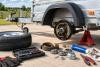
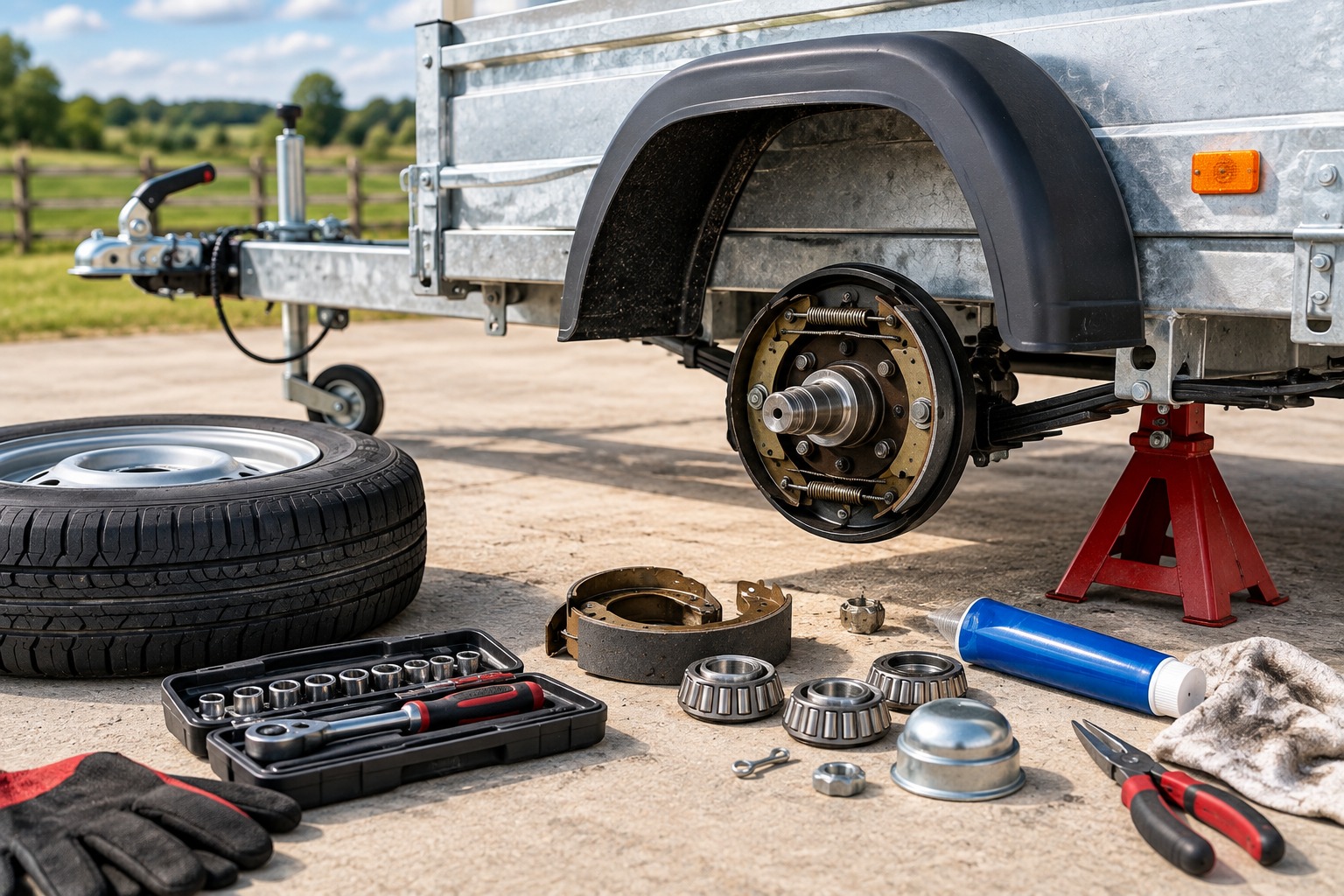
Start with the bearings. Jack the trailer and spin each wheel by hand — a correctly adjusted bearing will spin smoothly with no rumbling, grinding or resistance. Rock the wheel from side to side to check for play. Any noise or play means the bearing needs inspecting immediately.
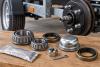
Remove the hub cap and check the grease condition. Fresh grease is smooth and pale; contaminated grease is dark, gritty or watery. If the grease looks poor, the bearings need re-greasing or replacing. Boat trailer bearings should be repacked with marine grease after every season. Browse trailer bearings at TrailerTek, including sealed, taper and bearing kits.
2. Brakes
On braked trailers, check the overrun coupling head for free movement and lubricate the pivot if stiff. Check the brake rod and linkage for corrosion and seized components — free them with penetrating oil if needed.
Check trailer brake cables for fraying, kinking and corrosion at the end fittings. A frayed or corroded cable should be replaced before it fails. Inspect the compensator (equaliser bar) for correct angle and free movement.
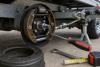
Check brake shoe wear through the adjuster hole on each backplate. If the shoes are worn to less than 2mm of lining material, replace them. Always replace trailer brake shoes in axle pairs. Adjust the shoes after replacement — refer to our guide on how to adjust trailer brakes for the correct procedure.
3. Tyres and wheels
Check tyre pressure against the manufacturer's recommendation — underinflated tyres are the most common cause of trailer tyre failure. Check tread depth across the full width of the tyre — the legal minimum is 1.6mm, but trailer tyres should ideally be replaced well before this point.
Inspect the sidewalls for cracking, bulges or cuts. Trailer tyres are vulnerable to UV degradation and can look fine on the tread but crack on the sidewall from age. Any tyre over five years old should be inspected carefully regardless of tread depth, and replaced at seven years as a precaution.
Check all wheel nuts are tight. The correct torque varies by hub — check your trailer manufacturer's specification. Loose wheel nuts are one of the most dangerous and easily prevented failures. Apply copper grease to the threads on reassembly to prevent future seizure.
4. Lights and electrics
Plug the trailer into a tow vehicle or use a trailer light tester to check every function: left and right indicators, brake lights, tail lights, rear fog light and number plate light. All must be working for the trailer to be roadworthy.
Check the plug and socket for corrosion on the contacts. Clean with electrical contact cleaner and apply dielectric grease to prevent future corrosion. Inspect the cable along its full length for damage from road debris, kinking or chafing against the trailer frame. Secure any loose sections with cable clips.
5. Coupling and breakaway cable
Check the coupling head for free and smooth operation. The handle should engage and release without stiffness, and the coupling should lock securely onto a towball with no play. Lubricate the coupling mechanism with a light grease or coupling spray.
Check the breakaway cable is undamaged and correctly routed — it must be attached to a dedicated point on the tow vehicle, not looped around the towball neck or hitched to the tow bar. The breakaway cable is a legal requirement on braked trailers and must be in good condition.
6. Chassis, suspension and bodywork
Walk around the trailer and inspect the chassis for cracks, heavy corrosion or bent sections. Pay particular attention to the area around the axle mounts and coupling. Surface rust is normal on steel trailers but deep pitting or cracking at structural points needs attention.
Check the suspension units for free and even movement. The trailer should sit level when unladen. Inspect the rubber suspension bushes for cracking or deterioration — worn bushes cause uneven handling and increase wear on tyres and bearings. Check any leaf springs for cracked or missing leaves.
Consider a service kit
If your trailer is due for a full hub service, a Ifor Williams service kit or Indespension service kit contains everything you need in one order — bearings, seals, hub caps, castle nuts and grease. It is the most cost-effective way to ensure all hub components are replaced at the same time, rather than replacing parts one by one as they fail.
Shop trailer parts at TrailerTek
TrailerTek stocks a full range of trailer parts at TrailerTek, including bearings, brake shoes, brake cables, service kits, lights and suspension components for all major UK trailer brands. Call us on 01962 774 988 if you need help identifying the right parts for your annual service.